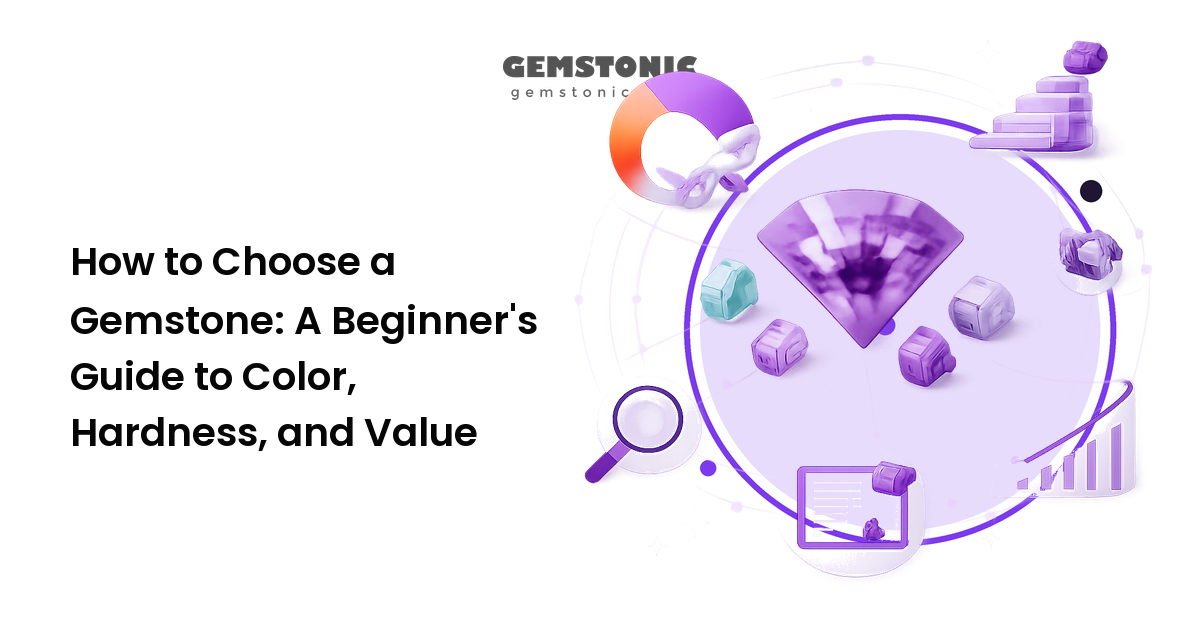
A gemstone can be a wedding-day keepsake, a birthday gift, or simply a color you fell in love with at a market stall. But the same word — "gemstone" — covers a diamond engagement ring meant to last fifty years and a soft, dyed stone that will scratch in a month. Knowing the difference is the whole game. This guide walks you through the handful of things that actually decide whether a stone is right for you: color, hardness, treatments, and proof of what you're buying.
The short version: decide how you'll wear it, then match color, durability, and budget to that use. A gorgeous stone in the wrong setting is a disappointment waiting to happen, and a plain stone that suits your life is a quiet win.
Why these factors matter more than the name
People often shop by gemstone name — "I want a sapphire" — but two sapphires can differ wildly in price and quality. What really determines value and wearability is a small set of measurable traits. Get those right and the name takes care of itself. Get them wrong and you can overpay for a treated stone or buy something too fragile for daily wear.
Color: the first thing your eye judges
For colored stones, color is usually the single biggest driver of both beauty and price. Gemologists break it into three parts:
- Hue — the basic color (red, blue, green) plus any secondary tint.
- Tone — how light or dark the stone is, from pale to nearly black.
- Saturation — how pure and vivid the color is, versus grayish or muddy.
The most prized stones usually have a strong, pure hue at a medium tone — vivid but not so dark the color disappears. There's no single "best," though. A soft pastel morganite and a deep royal-blue sapphire are both desirable; they just appeal to different tastes. Trust your own eye in natural daylight, which renders color more honestly than warm indoor lighting.
Hardness and durability: will it survive your life?
A beautiful stone you can't wear is a poor buy. Durability comes down to more than one trait:
- Hardness is resistance to scratching, measured on the Mohs scale from 1 to 10. Diamond is 10; sapphire and ruby are 9; quartz is 7. As a rule of thumb, stones below about 7 will gradually scratch from everyday dust, which contains quartz.
- Toughness is resistance to chipping or breaking. Some hard stones are still brittle, and some softer stones are surprisingly tough.
Match hardness to how you'll wear it
Be honest about use before you fall for a stone:
- Daily rings take the most abuse. Favor hard, tough stones — diamond, sapphire, ruby — or protect a softer stone in a bezel setting.
- Earrings and pendants rarely get knocked, so softer or more delicate stones like opal, emerald, or pearl are far safer choices here.
A soft stone isn't a bad stone. It just belongs somewhere it won't be scrubbed against keyboards and countertops.
Treatments: most gems are enhanced, and that's normal
Here's something many first-time buyers don't know: the large majority of colored gemstones on the market are treated to improve color or clarity. Common, widely accepted treatments include heating sapphires and rubies, and oiling emeralds to reduce the look of internal fractures. These are standard trade practice.
What matters is disclosure and stability. Some treatments are permanent and routine; others — like dyeing, fracture-filling with glass, or some color coatings — are less stable and should cost less. A treated stone isn't a scam, but you should know what you're paying for, because an untreated, natural-color stone of the same quality is rarer and worth more. Always ask, in writing, whether and how a stone has been treated.
Carat weight: size, but in context
Gemstones are weighed in carats (one carat is 0.2 grams). Bigger isn't automatically better. Two things to keep in mind:
- Price per carat tends to jump at round sizes and at larger weights, because big clean stones are rarer.
- Density varies by stone, so a one-carat ruby and a one-carat opal are different physical sizes. If you care how big it looks, ask for millimeter dimensions, not just carat weight.
Proof: certification and where you buy
For any significant purchase, get independent proof rather than relying on a seller's word.
- Reports from respected independent labs identify the stone, note treatments, and describe quality. They protect you on exactly the points that affect value.
- A clear, written receipt should state the gem type, weight, any treatments, and a return policy.
- Reputable sellers put this in writing without being pushed. Hesitation to disclose is itself an answer.
This matters most for expensive or "natural, untreated" claims, where the premium rides entirely on documentation.
A simple way to choose
- Define the use — daily ring, occasional earrings, a collector's piece.
- Set hardness accordingly — tougher stones for things you'll wear constantly.
- Pick color you genuinely love, judged in daylight.
- Ask about treatments and expect honest, written answers.
- Match carat to budget, and ask for size in millimeters.
- Get documentation for anything significant before you pay.
FAQ
What is the most durable gemstone for an everyday ring?
Diamond, sapphire, and ruby lead the field — all are very hard and reasonably tough, which is why they dominate engagement rings. If you love a softer stone, a protective bezel setting and an earring or pendant placement keep it safe.
Are treated gemstones worth buying?
Often, yes. Routine, stable treatments like heating are accepted across the trade and make beautiful stones affordable. The key is disclosure: an untreated stone of equal quality is rarer and costs more, so you should always know which you're buying.
Does a bigger carat weight always mean a more valuable stone?
No. Color, clarity, cut, and treatment status can matter more than size, and price per carat varies by stone type. A smaller, vivid, untreated stone can outvalue a larger, dull, heavily treated one.
Do I really need a lab report for a gemstone?
For inexpensive fashion stones, usually not. For anything costly, or any "natural" or "untreated" claim, an independent lab report is the proof that the premium is real — get it before you pay.
How can I tell if a gemstone is real?
At home you can't be certain; convincing imitations and synthetics exist. Some hints — like obvious bubbles in "natural" stones — point to glass, but a definitive answer comes from a trained gemologist or a lab report. When in doubt, have it tested.
Next step
Before you shop, decide how you'll actually wear the stone — that one choice tells you which hardness, setting, and price range make sense. Then match color and budget to it, ask for treatments and documentation in writing, and you'll buy a gemstone that fits your life and holds its value.