An engagement ring is the hardest job in jewelry. It sits on the most-used hand, gets worn while cooking, driving, and typing, and most people never take it off. That fact should drive the stone choice more than color, trend, or price.
The short answer: for a ring worn every day, choose a stone at roughly Mohs 8 or above with no significant cleavage — which makes diamond (10), sapphire and ruby (9), and moissanite (9.25) the safest picks, with spinel (8) close behind. Softer or cleavable favorites like emerald, opal, tanzanite, and pearl are beautiful but not built for daily wear on a hand.
That's the rule. The rest of this guide explains why it works, where it bends, and how a good setting can rescue a stone you love anyway.
What makes a gemstone suitable for daily wear?
Two properties, and most buyers only know about one.
Hardness is resistance to scratching — what the Mohs scale measures, from talc at 1 to diamond at 10. The number that matters isn't 10, it's 7: household dust contains fine quartz particles at hardness 7, so any stone softer than that slowly goes dull and hazy from nothing more dramatic than dust and handling. For a ring, aim higher — around 8 — because a hand meets abrasive surfaces constantly.
Toughness is resistance to chipping and breaking, and it runs on separate logic. It depends heavily on cleavage: the tendency of a crystal to split cleanly along flat planes where the atomic bonds are weakest. Diamond is the hardest natural material on earth and still has four directions of perfect cleavage — a sharp knock at an unlucky angle can chip one. Jade, meanwhile, sits only around 6–7 on Mohs yet is famously difficult to break, because its interlocking structure gives a fracture nowhere clean to travel.
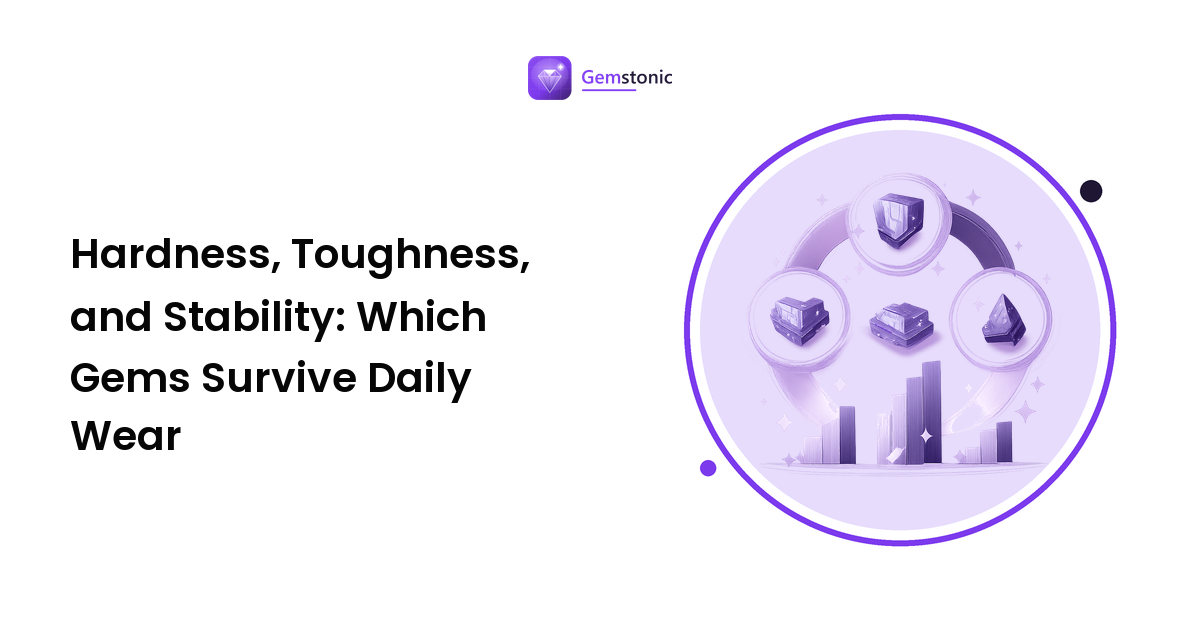
So "hard" and "unbreakable" are not the same claim, and a stone earns a daily-wear verdict only when both hold up. We cover the full framework — including chemical and light stability — in our guide to hardness, toughness, and stability in daily wear.
Which gemstones hold up best in an engagement ring?
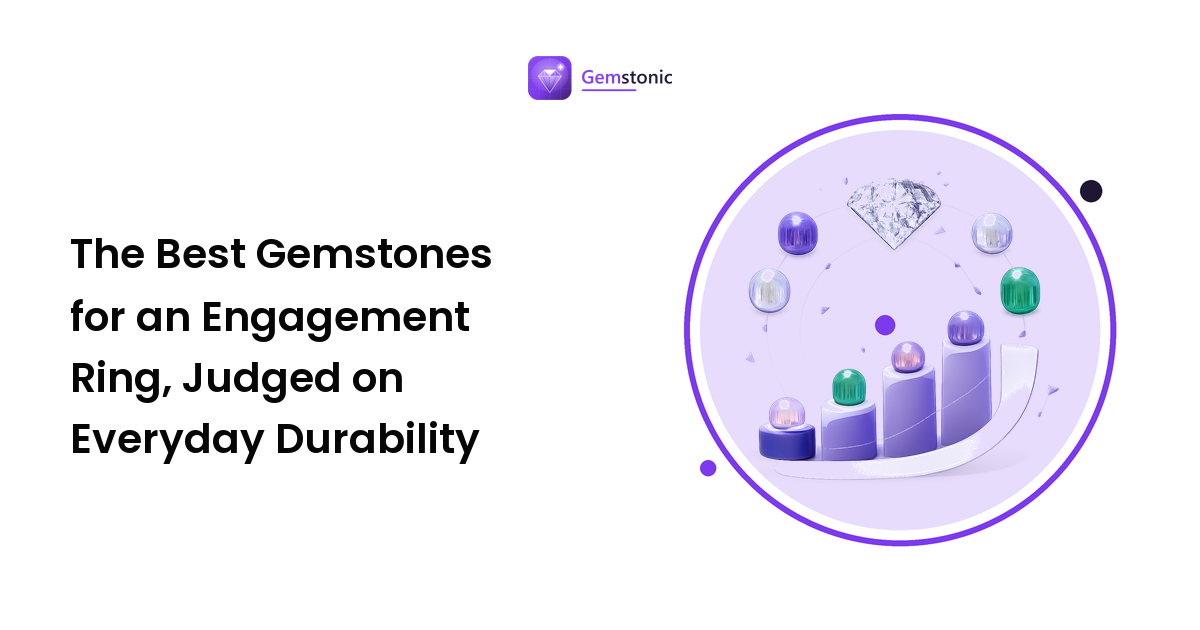
Here is the field, ranked by how well each stone tolerates being worn on a hand every day.
| Gemstone | Mohs hardness | Toughness / cleavage notes | Daily-wear verdict |
|---|---|---|---|
| Diamond | 10 | Excellent wear resistance, but four directions of perfect cleavage — can chip on a sharp knock | Excellent |
| Moissanite | ~9.25 | Very tough, no cleavage to speak of | Excellent |
| Sapphire & ruby (corundum) | 9 | Excellent toughness, no cleavage | Excellent |
| Spinel | ~8 | Good toughness, no significant cleavage | Very good |
| Topaz | 8 | Hard, but one direction of perfect cleavage — can split from a blow | Fair; use a protective setting |
| Aquamarine (beryl) | ~7.5–8 | Fair toughness; can carry inclusions | Fair; protective setting advised |
| Morganite (beryl) | ~7.5–8 | Fair toughness; abrades over years | Fair; expect eventual repolishing |
| Emerald (beryl) | ~7.5–8 | Brittle, heavily included, commonly fracture-filled | Poor for daily wear |
| Garnet | ~6.5–7.5 | Fair to good toughness, no cleavage | Occasional wear |
| Amethyst / quartz | 7 | Fair toughness, no cleavage | Occasional wear |
| Tanzanite | ~6–7 | Soft with distinct cleavage | Not recommended |
| Opal | ~5.5–6.5 | Soft, water-bearing, sensitive to heat and dryness | Not recommended |
| Pearl | ~2.5–4.5 | Soft, porous, damaged by acids and perfume | Unsuitable |
Read the two columns together, not separately. Emerald's hardness looks respectable next to garnet's — but emerald is the worse ring stone, because brittleness and internal fractures decide its fate long before scratching does.
Which gemstones should you avoid in an engagement ring?
Not "avoid" as in bad stones — avoid as in wrong job.
Emerald is the most common expensive mistake. It tests 7.5–8, which sounds fine, but emeralds are typically riddled with inclusions and internal fractures, and most are fracture-filled with oil or resin to improve clarity. That filler can be damaged by heat, solvents, and ultrasonic cleaners, and the stone itself is brittle enough to chip on a doorframe. Emerald rings are stunning; they simply require a protective setting and periodic professional care.
Opal is soft and contains water in its structure — in dry air or sudden temperature swings it can develop fine cracks called crazing. Tanzanite combines modest hardness with real cleavage, a double disqualification for a hand. Pearl is soft, porous, and dulled by perfume, hairspray, and even sweat. All four belong in earrings and pendants, which barely get touched.
Morganite deserves a fairer note: it's not fragile so much as merely adequate. At around 7.5–8 it holds up for years, but it abrades slowly, and a morganite ring worn hard for a decade often looks less crisp than it did new. Repolishing is possible — just know that's the deal.
Is moissanite a good alternative to diamond?
Yes — on durability grounds, it's one of the strongest choices available. Moissanite is silicon carbide, sits at roughly 9.25 on Mohs, and lacks the cleavage planes that make a diamond chippable. As a stone to wear every day for decades without thinking about it, it is genuinely excellent.
Its optical behavior differs from diamond's. Moissanite has higher dispersion, so it throws more colored "fire" — which some people love and others find gives it away at a glance. It's also doubly refractive, one of the ways a gemologist tells the two apart, as covered in how to tell if a diamond is real. Neither trait is a durability problem; both are worth seeing in person before you decide.
Worth separating from this question entirely: lab-grown stones are not simulants. A lab-grown diamond is chemically, physically, and optically identical to a mined one, and a lab-grown sapphire is real sapphire. They wear exactly like their natural counterparts, and the choice between them is about sourcing, value, and personal preference — not durability.
How should the setting protect a softer stone?
The setting is the half of the decision most buyers skip, and it can move a stone up a full category.
- Bezel settings wrap a metal rim around the stone's girdle, shielding its most vulnerable edge. This is the best protective choice for a softer or cleavable gem.
- Halo settings ring the center stone with small accents that absorb glancing impacts before they reach it.
- A lower profile keeps the stone closer to the finger, so it catches on fewer things. High-set solitaires look dramatic and get hit more.
- Prongs wear down over the years — six sturdy ones distribute a blow better than four thin ones, and all of them need periodic checking.
- The metal matters too. Platinum and 14k gold hold prongs securely; very high-karat gold is soft and bends more readily.
None of this makes an opal into a sapphire. But a bezel-set emerald in a low-profile mount is a far more realistic daily ring than a high-set prong solitaire in the same stone.
Frequently asked questions
What is the most durable gemstone for an engagement ring?
For all-around resistance to daily damage, sapphire and ruby (corundum) are arguably the best-rounded picks: hardness 9, excellent toughness, and no cleavage. Diamond is harder still and superb in practice, but its cleavage planes mean a sharp knock can chip it. Moissanite matches corundum's practicality closely at around 9.25.
Can you wear an emerald engagement ring every day?
You can, but you're accepting maintenance. Emerald is brittle, typically fracture-filled, and vulnerable to heat, solvents, and ultrasonic cleaning. If you want one as a daily ring, choose a bezel or halo setting with a low profile, remove it for cleaning and manual work, and have it inspected periodically by a jeweler who knows treated stones.
Is sapphire a good engagement ring stone?
It's one of the best. Corundum's combination of hardness 9, strong toughness, and no cleavage makes it the classic hard-wearing colored stone for rings — and sapphire occurs in far more than blue, including pink, yellow, teal, and colorless. It handles daily wear about as well as anything short of diamond.
Are lab-grown gemstones less durable than natural ones?
No. A lab-grown diamond, sapphire, or ruby has the same chemical composition, crystal structure, and hardness as its mined counterpart, and wears identically. The distinction is about origin, price, and sourcing values — not physical performance. Simulants like cubic zirconia are a different category entirely, and those genuinely are softer.
What Mohs hardness should an engagement ring stone be?
Aim for roughly 8 or above. Hardness 7 is the general threshold for resisting airborne dust, but a ring on a hand meets far more abrasion than a pendant does, so the extra margin matters. Then check toughness and cleavage separately — hardness alone won't tell you whether a stone survives a knock.
Choosing with confidence
Pick the durability first and the color second. Decide honestly how the ring will be worn — never removed, or slipped off for the gym and the garden — then choose from the stones that survive that reality, and let a protective setting extend the list. A stone you love that's slightly too soft isn't off the table; it just needs a bezel and a little discipline.
If you're weighing a diamond specifically, our guide to choosing a diamond and an engagement ring covers the 4Cs, lab-grown versus natural, and where the money actually shows. For per-stone hardness, toughness, and care details on any gem above, check its reference entry at Gemstonic.